
Author Evening with Cal Flyn 10 September 2026


We had a great HighlandLIT meeting on September 10, when the speaker was Cal Flyn, author of ‘Thicker than Water’, ‘Islands of Abandonment’, and most recently ‘The Savage Landscape: How we made the Wilderness’.
Cal introduced herself and her writing, and then spoke about the thinking behind ‘The Savage Landscape’, and read extracts from the book – leaving us in each case at cliff-hanging moments. Then, in the second half of the evening she answered questions from the audience.
‘The Savage Landscape’ is an attempt to chart ideas about ‘wilderness’ from ancient times until the present. Cal made the point that our definition of wilderness is based on our own perceptions. We project our own thoughts on to terrain and on to wildlife. Our ideas of ‘nature’ may vastly differ from the reality. To some, wilderness denotes physical landscape; to others, it’s a place of encounter with nature, other people, other worlds.
Cal explored ideas of wilderness: as a place of withdrawal and spiritual encounter; the Romantic view of wilderness as wild, sublime beauty; and more modern perspectives of wilderness as places in which species and habitats are preserved. She discussed the difficulty of even defining wilderness, and the different perspectives of the geographer and the conservationist. She investigated the ethical issues involved in conservation – in places indigenous peoples have been driven off their historical homelands, and elsewhere the creation and maintenance of wildlife conservation areas are only possible as a result of the income stream from big-game hunting. She unpacked the connection between spiritual beliefs and wilderness, as nature and wildlife thrive in places considered to be dwelling places of the gods and as such left untouched.

Cal wondered as she approached writing the book if she could unfold the story, tease out and develop the theme as you would if you were writing a novel. Each chapter explores a particular idea relating to ‘wilderness’. Cal researches each idea with a ferocious intensity, finding out and reading works by the key experts, the main thinkers, creating a vast research document. She sees her work as something akin to sculpture. Here’s the block of wood. Here’s the Word document of facts and information. Cal carves away the research until what is left tells a story,
illustrates a story, as her mind makes unexpected connections and in time the chapter is written.
But her research is not simply word-based. For each chapter she tried to find what journalists call ‘a camel’ to carry the story – a person or group of people whose situation illustrated and embodied, and brought alive the them of the chapter. Having found her ‘camel’ Cal goes and spends time with them, experiencing their lives intensively – often at some risk to herself.
So the block of research from which each chapter emerges includes not just information and ideas, not just the experiences of people who illustrate the theme, but also Cal’s visceral perceptions and total engagement. It is that – her intensity of thought and action and above all emotional engagement – which makes her writing profound.
One of the sections Cal read to us described her quest on Iceland to look into the crater of an active volcano. It wasn’t enough for her to see the sublime in the mountains – that had been seen and written about before. She sought a deeper level of sublimity and awe, and pushed towards the fire and smoke, going miles past the warning signs until she saw the ‘terrifying beauty’ of the fiery molten mountain. But in going this far, she realized that she had moved beyond the sublime to the place of terror. The Romantics took no risk in their pursuit of sublimity.
In the end, Cal came back to appreciating wilderness, whether or not it exists, or can be defined, as a powerful ideas, worthy of our respect and the last chapter features her experiences in the Cairngorms, her own known wilderness where she is not an outsider, yet one which demands the utmost respect.
In the process of all this, she gave insights into the struggles of the writer. Knowing when to stop researching and start writing; the importance of beginning to write when research is still incomplete; knowing when the book is finished. Cal explained that she likes to have some output for every work session, although the output will differ at various stages of creating the chapter. It may be a note, summarizing ideas; if may be a simple paragraph, which, much edited, might find its way into the finished text.

We deeply appreciated Cal’s talk – but there was more! After the break, she took questions. Here are just some of the things discussed at the Q&A:
How big does an area need to be to be defined as a ‘wilderness’? That depends. The geographer might say there has to be ‘100,000 hectares of unbroken primary landscape.’ Another specialist’s definition could be a much smaller area – where a particular plant or species of animal is thriving.
Are buffer-zones between antagonistic nations places of ecological richness? Yes! Cal spoke of animals thriving in areas where landmines had been sown. A place where unspeakable things have happened can be a place of ecological treasure.
Did Cal discuss Nan Shepherd in the book? Cal said that Nan Shepherd had certainly fed into her way of thinking: she loves Shepherd’s ‘sensuous language’.
How was Cal regarded by others while on her research trips. Was she seen as ‘the interfering journalist’? In her reply, Cal instanced her visit to Mozambique where she was allowed to accompany a group of big game hunters. It was, she said, rather a ‘weird’ relationship. She was surprised they let her embed herself in the group, since they knew she was probably going to be critical, and feared bad press. They were friendly towards her – but then they remembered that there was, as she put it, ‘a mole in the camp’. In general however, she found them open to hearing her ideas. But the relationship remained ambiguous, and it was not always easy to differentiate what was ‘on the record’ from what was not.
Were the ideas in the book imported into the various locations, or did they arise through engagement with these places? Cal was aware of the colonial approach to the definition of ‘wilderness’, described by those out-with the territory as being ‘unknown’ and ‘threatening. But she has always been drawn to wilderness, and her work reflects personal engagement. The book finishes with a chapter about her experiences of the wilderness of the Cairngorms – one in which she is an ‘insider’.
How did Cal honour the views of the different people she came across? She said the hardest chapter to write was the Brazilian chapter about the Yanomami people, who have resisted outside attempts to influence them. The image of them was of a fierce, warlike people, but she had also been told that they were ‘very gentle, spiritual.’ She found it hard to fully understand the situation, as because of language differences she was communicating through a chain of people. But she did not want to fall back on the old stereotypes, and tried to write honestly about the people’s history, and their anxieties.
Cal was asked about her writing process, and particularly about the times she doesn’t quite know where the chapter is going. Cal told us that she looks for some outcome from each work session – and the outcomes would be different at each stage in the process. And ideas do come in, often unexpectedly. Encouragingly, she says ‘you always find it in the end’.
Cal was asked what her thoughts are on the big issues of landscape and wilderness. She replied that the dominant mode of conservation just now is rewilding, which can include making things more wild. A concern for rewilding is excellent, because it reflects the desire to benefit the environment. But ‘good intentions’ are not always followed by ‘good outcomes’.
The geographer would say there is no wilderness in the Scottish Highlands – but, says Cal areas of the Highlands certainly feel to her like wilderness. She also noted that ‘non-official wildernesses’ are being created as people get involved in their local areas.
How did it feel to be a women in difficult places, Cal was asked. While sometimes it was necessary to have a guide or an interpreter, Cal prefers to be on her own if possible, allowing herself to feel things, to psychologically immerse herself in the experiences.
Would Cal consider going up in space to sample an extra-terrestrial wilderness. ‘If I’d been asked that when I was younger, I would have said “Yes”, but not now!’
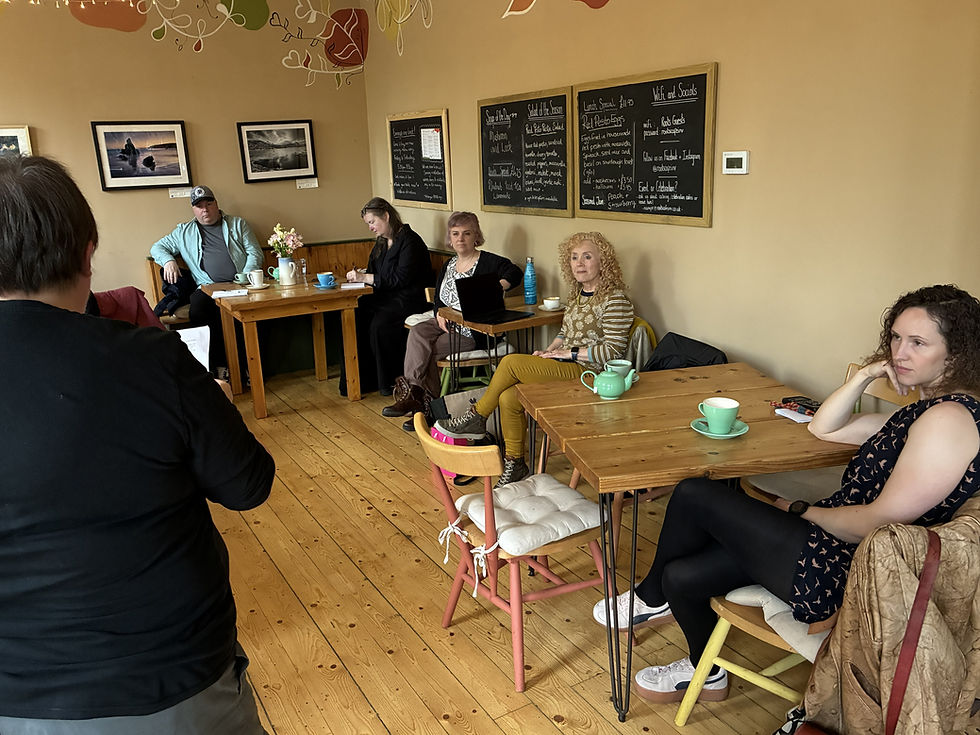
And with that, the evening ended. Many thanks to HighlandLIT Chair Marina who chaired the event, to Cathy for bringing the speaker system, and to Rebecca and her team at Roots Café for the venue, and the wonderful coffee!
(Many many thanks to Marion, Marina and Steve for the evocative photos of the evening!)


Comments