
August 2026 Open Mic

Report by Margaret Chrystall, Photos by Marion Timperley
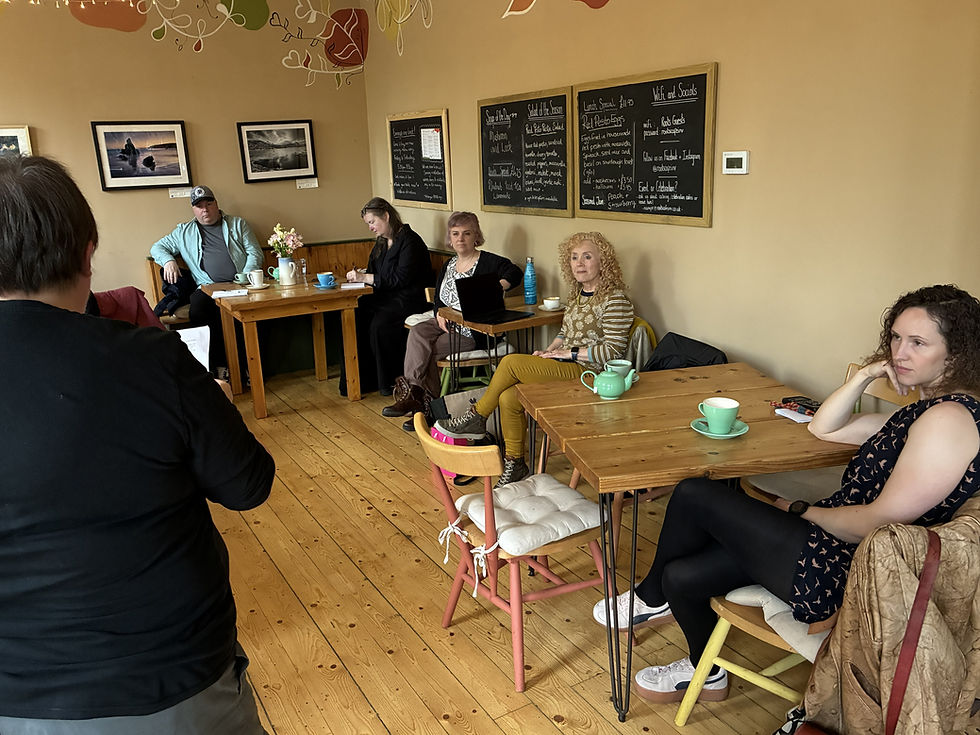
Although several regulars were on holiday, there was still almost a full line-up of those sharing their own work at HighlandLIT open mic night at Roots on Thursday 13 August.

With less than a month to go before the first writer event held by the organisation in a while, hosting award-winning Cal Flyn, there was a reminder that tickets would soon be on sale via Eventbrite. Cal, who is originally from the area, went to school at Charleston Academy. She will be talking about her latest book The Savage Landscape on Thursday, September 10.
At August’s open mic, the first of nine readers was Simon Berry, wryly observing that ”somebody had to start” as he opened the night with two pieces. The short, menacing flash fiction The Lane came first. A man with “a piercing look” and a long staff was stopping the story’s narrator from taking a normal path - on the authority of the “Lane Closure Executive”.
“Sinister…” remarked regular reader Tim Williams afterwards. In Summer’s Past, Simon mused on the season, revealing he had aimed for around 500 words. “My cinquecento!”
John Dempster, HighlandLIT’s host for the evening, commented he had particularly liked Simon’s opening story and its “metaphysical reflection on lost opportunities”.
Timski (Tim Williams) read part of Coffeehouse Schmooze by Clive Grewcock from Golspie which had been dropped off at the venue, the Roots café, before reprising a feat of memory he had made for the slam poetry event at the recent Belladrum Festival.
“I’d failed dismally to memorise for the last four years, but this year I did recite one from memory. So tonight will see if I have retained it in my memory!” Tim said.
The poem with its two voices showed how everything seemed initially, before the second voice piped up “No, my friend …” putting the ‘real’ side of the situation.
“The aliens are not coming to save us or destroy us … we are the only rats in this cosmic maze,” went the first point of view.
And later: … “No my friend, this is not the present the past might have had in mind, this is the same old future creeping up on us from behind.”

John thanked Tim for reading both the haiku and “these reflections on aspects of life”.
Steve Robertson returned with a story The Road To Culture that moved away from the Dingwall bus journeys that have featured before in his stories. In a twist, though, the new one referenced a bus story - Bus Diary Entry 1,003 in it – which he’d shared in the past! But in the new one the location was a different open mic group he was invited to attend with a musician friend. Steve (the character) is asked to round off the night with a story, but it’s interrupted as he reads when a couple get up and start saying their goodbyes.
In the story, Steve is disheartened, comforted by his friend who notes that he looks “shaken” and attempts to cheer him up.
“He said he liked it and gave me a fist bump.” But the friend’s final words of wisdom are a classic dry and deft kiss-off from writer Steve – and drew a big laugh from the listeners.

Catherine Rose McAleese returned to the memoir she had shared with HighlandLIT last time.
She writes about being a young girl growing up in Birmingham where her mother ran a pub. Catherine laughed: “My mum had a wonderful way of styling it out with grace and dignity. I’m not sure how she managed that but she did and this is an example of it, here in the swiftly-moving chaos of being in a pub on a football day.
“I grew up near the Blues [Birmingham City] ground, so we could hear the football match taking place while we were in the pub.”
Catherine shared what John later called a piece of writing that was “so vivid, so alive, and evocative of the senses and praised “the wonderful last line”.
Though moments of the memoir were grim and subtly menacing, elsewhere Catherine deftly described pub life, including how the sound of a match animated it.
“The live TV is slightly out of synch with the wails that stretch through the air from the football ground. I hear the eruption of the goals scored over there and then like an elastic band pinged, it reaches the TV in the pub and it flings the viewers into noisy activity, suddenly lurching, exclaiming loudly, throwing their hands up, celebration, outrage. I want to feel their emotions, share their common interest. But also, it makes me want to crouch down behind the bar, evaporate into the soapy steam of the glass-washer.”

Nadia Johal revealed her poem Restricted Entry had come - as she said much often does - from a line in a dream she had written down. This time it was about “my experience of being marginalised”. Considering a closed door with a sign, the wondering includes the thought: “There is a sign on the door. You wonder if the door is locked. What if there is a divine oasis on the other side?”
John noted the piece’s deep reflection on exclusion and how that feels. And he liked the repeating line “There is a sign on the door …”.
Later Steve Robertson pointed out that two of Nadia and Simon’s pieces were both looking at the idea of ‘no entry’.

Host John wondered if next reader SJ Groenewegen would be sharing more of a continuing sci fi narrative. But … it was something different this time.
“This is the prologue of a work in progress I’ve got which is actually an on-spec police procedural and the working title for it is Where The Crows Cry – and I’m not doing accents!” SJ laughed.
It opened in the Highlands: “Scotland doesn’t have wild animals …”
SJ presented a couple camping, Tristan revealing that his family had previously fled the Black Isle “for reasons unknown”. And it’s about then that the strange behaviour of local birdlife starts to send a shiver down the spine …
Then - “The corpse wasn’t what either of them had expected…”
As SJ finished the extract, John queried: “What is the significance of the body and will we find out why the family fled the Black Isle? Thank you, SJ. Nicely set up.”

Ewan Hardie had three poems to share and performed them from memory – “One is more conceptual and the other two are more personal”.
The confident delivery of Standardised belied Ewan’s opening words – “I’m a total amateur”. But mesmerised by the flow of his words, the audience were surprised when this poem - and the second – ended and they clapped and laughed in surprise. In second poem 2024 Knocked On My Door, Ewen said there was “some existentialism and mortality” in the poem which referenced time passing – “there is a clock ticking deep inside”. Finally, in When Anna Came Over, the “spoils of this war” are “tenuous, delirious, contagious”.
John commented how well-delivered Ewan’s poems were.

Malcolm Timperley said: “This is an oldie revamped it’s called A View To A Kill for any Bond fans in the audience.” A writer opens a two-handed conversation asking whether he should write “a prose piece or a poem” for “tonight, really”, the current open mic we were experiencing!
“Definitely go for poetry. It’s easy. You just shove the words down. With prose you have to write sentences and with poems you don’t have to bother with any of that! The more scrambled and unintelligible it is, the more it is considered to be real poetry!”
The audience - probably most of them used to struggling with the challenges of writing prose, and poetry - appreciated the humour of the exchange. The night’s final piece, an officespeak spectacular called A Braindump In The Thought Shower, presented a conversation between Malcolm and God with management jargon artfully flourished.
After resounding applause, John rounded off the night praising the final “… two clever and thoughtful pieces”.


Comments