
June Open Mic

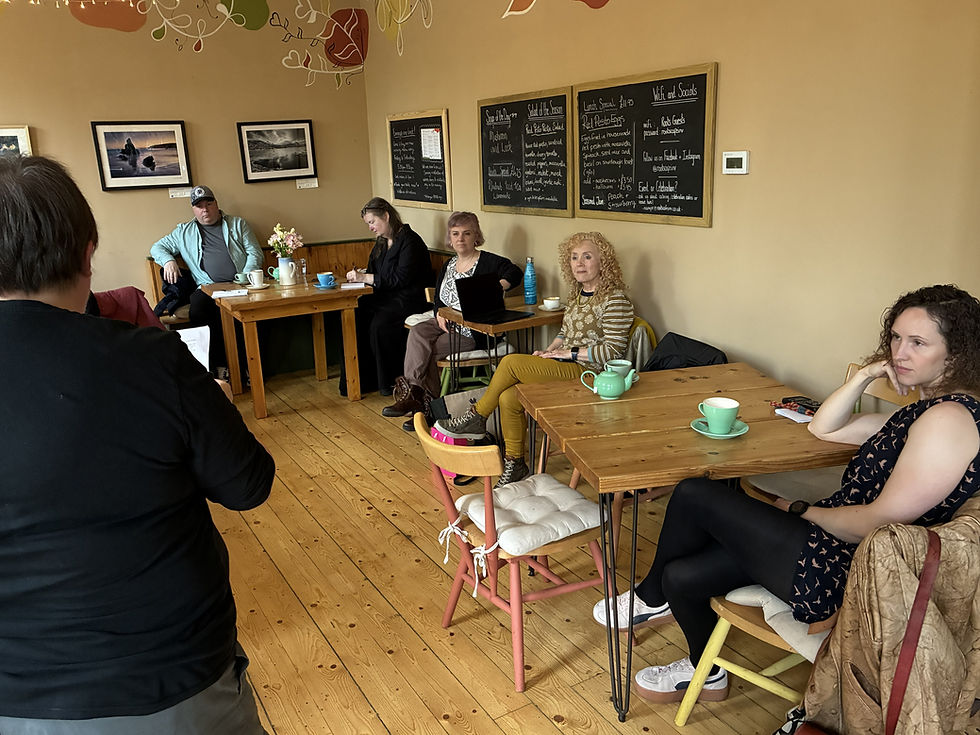
Report of the June Open Mic by John Dempster with input from Margaret Chrystall
We had a great time at the HIghlandLIT open mic on Thursday 11 June. There were eight readers, and the evening was hosted by Marina Gertsen, Chair of HighlandLIT.
First up was S.J. Groenewegen, who read her short story ‘Uneasy Choices’ set in the future in an Amsterdam which has been transported across the galaxy from a stricken earth. We meet Amalia, a canal tour guide, suffering PTSD following a time as a peacekeeper on ‘a satellite world’, we hear of information stored inappropriately and used against an oppressed minority, there’s a bomb explosion, but not the conventional kind threatening death and destruction. Amalia, with a strong family tradition of self-giving service in the interests of peace ‘always thought it best to remember that darkness is never forever.’ An intriguing, complex, deeply thoughtful piece.
Next, we heard from Timsky two powerful, eloquent pieces declaiming about human disregard for the environment and its consequences. ‘Revolt’ described an incipient rebellion by the natural world – animals, birds, plants, all non-human life somehow communicating and planning a rebellion in the light of a thousand years of ‘persecution, exploitation and extinction’. There are early signs of this revolt – animals behaving differently, foxes walking down the street unafraid – but no indication that humanity has understood the incipient revolt or what its aim is – the utter destruction of the human race..
The second poem was a powerful cascade of words against human indifference to the environment. ‘Eden is a tip’. Humanity has abandoned the garden of good and evil for the penthouse, and is ‘poisoning nature.’ And wildlife documentaries, far from allying with the environment are in fact further examples of exploitation. We ‘consume the present like locusts’ thundered Timsky. Humanity is guilty of what he calls, in a wonderful coinage ‘country-cide’. But we face a revolt!
Then we heard from Fran Smee, who read an abridged chapter from her vivid, humorous novel A better end, about three over-60s women, Lesley, Harriet and Mary who seek a future as well as a past, and live together on a remote Scottish island. Far better than living alone and hating it, they feel. Chapter 9, ‘I read the dictionary, offered Lesley’ tells the wonderful story of the trio advertising for a companion to join them, and their encounter with the formidable Margaret Macdonald, a former matron, who carries herself ‘like a battleship’. She decides ‘I’ll visit for fun’ and rocks up with her dachshund. She is mystified by the trio’s lack of a structured programme – ‘we just do what we want’. There are marvellous phrases such as ‘the sand of time slipping through the hourglass of your life’ and the description by Mary’s daughter Erin of their commune as a ‘home for genteel geriatrics who don’t want to talk to their children.’ Brilliant, perceptive writing.
Next up was Simon Berry a retired journalist who is part of a Ross-shire writers’ group. He is interested in what the voices of those he hears around him are saying. He read some reflections written from the time of the 2016 referendum until the COVID pandemic. He has a brilliantly-titled unpublished collection of work called ‘Anger, Man. Age.’
‘The well-informed’ expressed the apparently all-seeing, all-knowing voice of those in the community who seek to enforce tradition, and insist on everyone conforming. ‘We’re fighting an invisible enemy here’; ‘Help defend our liberty’; ‘Shut the curtains at night.’
‘A herring gull speaks’ gives voice to a gull looking through someone’s window. ‘I know your routine,’ says the gull ominously. It is not satisfied with the ‘fishy crusts’ which the person sometimes offers it. The gull protests that it is taken for granted. The person simply goes away and assumes the resident gull will keep the other gulls away, says the bird, indignantly. Yet it burns energy keeping watch from 9 to 5. Retaliation is necessary for this lack of appreciation – a live catfish dropped in the hallway. ‘Next time,’ threatens the bird ‘You won’t get off so lightly. Your kind made me what I am.’
Simon lived in Glasgow for 40 years, and ‘Mr and Mrs Thismenos’ vividly described the Greek couple now living in the city, with whom he lodged. The ‘bourgeois’ pair adopted him because he was a journalist and that impressed them. Their lives showed that borders could be crossed, new starts made. But in the end he left, leaving bills unpaid, hoping they would understand.
He also read ‘Home Life, Street Life’ a piece about his first flat in Glasgow – in poor condition, but it was his. At last he had control of his own space. He describes the view of the street from fifty feet up, the sex workers lining the kerb. One night he hears the word ‘Help!’ and the tinkle of broken glass. He flings up the sash and shouts ‘I’m calling the police!’ But should he have done more?
The next reader was Virginia Hamlet who read three poems. One was ‘The challenge of believing’. ‘You didn’t mean that,’ someone says. But in saying those words, they are making the speaker out to be a liar.
‘Number of travellers – one’ was a marvellous short poem about someone selling their engagement ring, buying a back pack and setting out on holiday, finding it a much better companion than the person who gave her the ring. It contained the poignant line ‘You knew how to make me happy, you just didn’t like to do it’ which seemed so sad, and yet an insightful perspective on a former partner who seemed to withhold love and approval. And we loved the third poem, ‘The rules for relationship CPR’:
Continue until recovery
Or until help arrives
Or until you cannot go on
Steve Robertson read a short story, ‘The Jamestown Menace’, a clever, humorous story set in 2016 about two encounters with someone whom the speaker had idolized at school, years before. Andrew McGhie had been a star of sports, and the PE teacher had always cast him up to the younger boy ‘You’ll never be like Andrew McGhie’. But McGhie has not had the starry future which seemed to lie ahead for him, and after two trips on the same day on the Contin bus with him the speaker is in the end very glad that he is ‘not like a man who doesn’t have a pot to piss in.’
Next up was Stephanie Riffort who read three vignettes. One, un-named, about two voices, speaking different languages, each person ‘alone in linguistic insularity’. But one of them has ‘the power’ in the conversation, and puts the other ‘in the emotionally undeveloped box’.
Stephanie read ‘Italian Holiday’ – about a woman on holiday, feeling the fear and anxiety returning while she seeks to ‘focus on the present’ and reminds herself that ‘nothing is forever’. We wonder what traumatic event she has left behind. ‘Was this escape,’ she wonders ‘Or the distance she really needed’? But at least, she concludes, it has given her perspective.
Finally, Stephanie read another nameless, intriguing poem beginning ‘Postcard from the past. A broken watch stuck on 7.45.’ Is the drawing on the postcard from before, or is it an offering to become?’
Lastly, we heard from Euan Sinclair who read a striking poem about ‘the hollow chamber of time’. That phrase frequently punctuated this bleak, beautiful, hallucinatory incantation of poem about a long voyage down a river – the river of life one supposes - in a boat, passing the ‘cities which grew up amongst the dead’ to house the living, listening to voices offering freedom and wisdom. Eventually, the vessel lodges in ice, but no-one dares to venture out on the frozen surface. ‘Voices moaned, wept / Winds blew as we grew old in the hollow chamber of time.’
And then, to conclude the evening Marina thanked the participants, summarised the themes the readers had explored, and invited us all back next month, on 9 July 2026 at the same time and venue to do it all again.


Comments