
'An enthusiastic reboot': Open Mic on 14 May 2026
- John Dempster

- May 19
- 6 min read

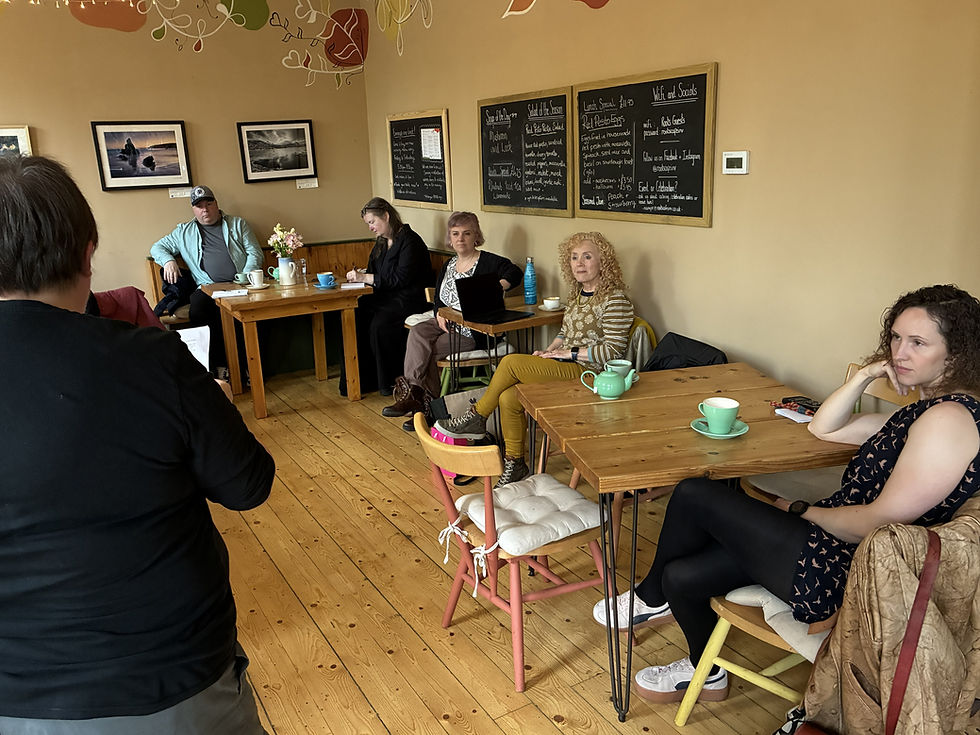
Here's a lovely report from Margaret Chrystall of last Thursday's wonderful HighlandLIT Open Mic! The photo is by Steve Robertson.
At May’s Open Mic night, HighlandLIT’s new chairperson Marina Gertsen introduced the event before nine people read – poems, short stories and extracts from longer work.
If a recent call on socials had suggested the group needed new blood to survive - and was even considering the death of the group - the energy of those who came along to read, and the quality and range of their work, brought an optimistic spin to the night which felt more like an enthusiastic reboot than a wake!
“It is always very entertaining – and tonight we’ve been to space, the dark side of the moon, Dingwall, to Hull and back, looked at big stars, into grief, AI, what it means to be human… And told we are Indigo Children!” Marina added, referring to second reader Tim Williams’ theory that we were all people with some special abilities.
Writer and artist Marina – or “the very new chairperson” as she introduced herself also revealed two new committee members, including event promoter and musician Steve Robertson.
“We are still rising from the ashes and there’s a great turnout tonight,” she said, also thanking those present.
Marina also reminded everyone that a couple of people are still needed for the committee, particularly those with digital and graphic design experience. An incentive might be that membership fees would be waived for those taking up a committee role.
Scott Fraser was the first to read in the five-minute slots that make up the group’s Open Mic nights
Scott was the first of two people transporting us to a sci fi setting in Scotland. He quickly created a memorable scenario. “Finlay was trying to release a sheep from a barbed-wire fence when he heard a sonic boom and saw a star fighter. He stood up to get a better view…” Another craft was coming “up the valley … a multi-combat craft … most of them were unmanned.” But Finlay spots a figure and worries that “… Mairi was safe indoors”. Also mentioning people spontaneously combusting, Scott had helped us travel far and fast in his brave new world - and left you itching to find out more.
Sci fi was also shared by SJ Groenewegen later. The story Storm Warning, set in its “nearish-future world” with a “vocab-bot” features in an anthology from Bonar Books. The extract focused on a team living on a satellite weather station needing to solve a problem in a way that was probably not what leader Lex wanted to hear, as the dry wit of Morgaine pushed boundaries of taste and made the HighlandLIT audience laugh in this authentic-feeling snapshot of a future life.
Tim Williams talked in his introduction about five poems he was going to read. “I know that sounds daunting, but they’re short!” he grinned, before suggesting we might all be special “Indigo Children” whose qualities included being “intuitive, spiritual, with psychic abilities and empathic”. But we weren’t intuitive enough not to clap “sporadically” between each of Tim’s five poems, starting with Broken News, until he suggested we might just want to save clapping till he’d finished them all. Domestic Harmony closed the series of surreal images and tongue-in-cheek spin from Tim with a reversal of time – “just the past creeping up on us from behind”.
Lilian Ross offered poems in both English and “her own language”, Doric, reading from her book Jist Sayin… (Doric Books). From looking at the moon, Lilian’s selection also took us into the now with Ostara, named for the spring festival which marks the return of the summer and the sun. The strong presence of the feisty dandelion in Dandy’s Din came with expressive Doric words to declare its value to the world “…coffee from my lang, lang root … Ye can mak from me jam and wine” and “… my sunny heid deserves to be seen as mair than jist a weed”.
Steve Robertson was one of a courageous duo on the night who read their work out for the first time. He ruefully smiled: “I feel like everyone has got a book already or something written out – I am reading on my phone!” He told us he had written Bus Diary, Entry 1,003 last October during a time he was travelling a lot by bus from Inverness to see his parents with some of the story based on reality and some from his imagination. The story was triggered when one day a couple got on with “the sound of clanking bottles as they move to the back of the bus”. With laugh-out-loud moments and a comic’s timing, Steve took us on a trip that was everything from “a joyride” to “the bus from hell”.
David Goldie shared a sequence of poems including Move 37 and, based on the name of an algorithm, The Monte Carlo Tree Search. It was inspired by the ancient game of the East, Go, and its modern popularity, millions of people watching the Deep Mind Challenge Match in 2016, when a landmark in AI history saw human player Lee Sedol taken on by Alpha Go, an AI model trying to outwit a human in Seoul, South Korea. The game’s popularity, David told us, was like “Scotland playing in the World Cup”. The poems reflected the action and tension of the event: “… rooms alive with the clicking of stones on boards … the flow of all these people, each leaf unique”.
Nadia Johal responded to the death of a young friend giving an emotional first-time reading in public. Battling to overcome almost overwhelming grief in four poems, often the writer addressed her absent friend as if she was still present, as in first poem Morning Pages. Sometimes the image of a rabbit played a part, a fleeting presence as in A Rabbit In The Woods. Lines lingered and rhyme powered Hold Hands With Chance: “The clock still ticks, but without your chime.” And I’ll Keep A Look Out was more like a letter, Nadia said, asking to “see you again” - “My cat’s taken to sitting on your front step.” Chairperson Marina commented after the poet had finished that it was wonderful to be so brave in using writing to process “all these huge things going on”.
Colm Black read two poems about horses “one mine, one not”. The first was Irish poet Michael Longley’s The Horses from the Bloodaxe anthology Staying Alive, in which the poem’s first line reads: “For all the horses butchered on the battlefield”. For his own poem - Promises, Promises - Colm explained that in Ballycastle, the Ould Lammas Fair also still includes a horse fair and is “a strange mix of new and old Ireland”. The poem described a horse “… its tail will fall through our hands as easy as sand through fingers” and a place “… loitering in a pasture more mud than grass, somewhere near Dervock, head down in the winter rain”. Colm mentioned he had written the poem at the time of the Belfast Agreement, which had seen promises made people weren’t sure they would keep. [The Belfast Agreement in 1998 was part of the process which eventually set up a devolved power-sharing government.]
Malcolm Timperley was the last to read with Return To Sender, a story he joked he had discovered “in a last trawl in the sludge at the bottom of my laptop” and revealed the setting was Hull prison. The story began with a very personal message in a bottle that enticed the listener in, as a long-running mystery played out and was solved with a satisfying twist, perfectly timed a second before the end.
The next HighlandLIT Open Mic will be held on Thursday, June 11 at 7pm at the Roots Café at the top of Stephen’s Brae [where Crown Avenue meets Stephen’s Street]. For more information on the group or becoming a member, go to www.highlandlit.com
If you would like to request a reading slot, email: highlandlit.com@gmail.com


Comments